6 Best Map Design Innovations
Maps aren’t just geographic tools – they’re historical artifacts that reflect the world’s most pivotal moments. From wars that redrew borders to discoveries that expanded horizons you’ll find that major events have dramatically shaped how cartographers design and present our world.
The relationship between history and map-making reveals fascinating insights about power politics territorial disputes and cultural perspectives. When you examine historical maps closely you can trace the fingerprints of colonialism revolution and scientific breakthroughs in every line and boundary.
Disclosure: As an Amazon Associate, this site earns from qualifying purchases. Thank you!
The Age of Exploration Sparked Revolutionary Cartographic Innovations
The 15th and 16th centuries transformed mapmaking from medieval guesswork into precise navigational science. You’ll discover how maritime exploration demanded accurate charts that could guide ships across unknown waters and safely home again.
P.S. check out Udemy’s GIS, Mapping & Remote Sensing courses on sale here…
Portuguese and Spanish Maritime Charts Revolutionized Ocean Navigation
[lasso id=”17043″]
Portuguese portolan charts introduced compass roses and rhumb lines that you can still recognize in modern navigation. These detailed coastal maps featured accurate harbor depths, wind patterns, and dangerous reef locations gathered from decades of systematic exploration. Spanish casa de contratación maps standardized longitude measurements and established the first global coordinate systems. You’ll find these innovations directly influenced how cartographers measured oceanic distances and plotted intercontinental trade routes that connected Europe with the Americas and Asia.
Dutch Golden Age Maps Dominated Global Trade Routes
Dutch cartographers like Willem Blaeu created the most accurate world maps of the 17th century using advanced surveying techniques. You can observe how these maps emphasized profitable shipping lanes, strategic ports, and resource-rich territories that supported the Dutch East India Company’s global empire. Amsterdam’s mapmakers developed sophisticated printing methods that produced detailed atlases showing precise coastlines, prevailing winds, and seasonal navigation patterns. These commercial maps prioritized economic information over decorative elements, establishing the foundation for modern business cartography.
[lasso id=”6005″]
World War II Transformed Military and Strategic Mapping Techniques
World War II marked a revolutionary shift in mapping precision and methodology. The conflict’s demands pushed cartographic innovation beyond traditional surveying methods.
Aerial Photography Integration Changed Topographical Accuracy
Wartime aerial reconnaissance transformed how you could capture terrain features with unprecedented detail. Military cartographers developed photogrammetric techniques that converted aerial photographs into accurate topographical maps within hours rather than months.
[lasso id=”17137″]
Key innovations included:
- Stereoscopic photo interpretation for elevation mapping
- Grid reference systems for precise coordinate plotting
- Rapid field map production using portable printing equipment
These techniques reduced mapping errors from hundreds of meters to just a few meters, establishing standards you’ll recognize in modern GPS-based surveying.
Secret Intelligence Maps Influenced Post-War Geographic Standards
Intelligence agencies created classified mapping protocols that later became civilian cartographic standards. You can trace many current GIS data classification systems back to wartime military mapping requirements.
Critical developments included:
- Standardized symbol libraries for military features
- Multi-scale mapping systems for tactical and strategic planning
- Coordinate transformation methods for international map sharing
Post-war declassification of these techniques provided the foundation for modern digital mapping standards, including datum systems and projection methods you use in contemporary GIS software.
[lasso id=”16024″]
The Cold War Era Redefined Political Boundary Representations
The Cold War’s ideological divide fundamentally transformed how cartographers represented political boundaries, creating new visual languages for depicting contested territories and spheres of influence.
Iron Curtain Divisions Altered European Cartographic Conventions
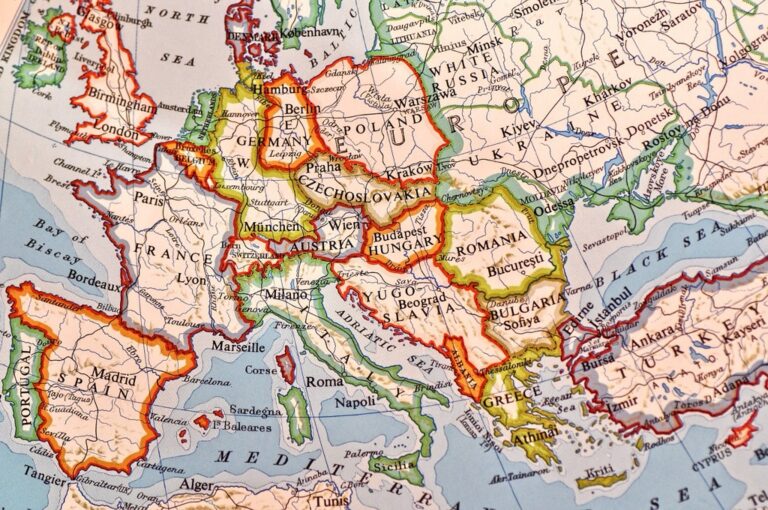
Iron Curtain cartography introduced distinctive visual elements that separated Eastern and Western European territories. You’ll notice Cold War-era maps used bold red lines to demarcate communist boundaries, while Western territories appeared in blue or neutral tones. Cartographers developed specialized symbols for divided cities like Berlin, employing dashed lines for contested zones and solid barriers for physical walls. These mapping conventions influenced how you interpret political divisions today, with similar visual techniques still used for depicting disputed territories and military demarcation lines.
Space Race Technology Advanced Satellite Mapping Capabilities
Satellite reconnaissance programs revolutionized mapping accuracy during the Cold War competition. You can trace modern GPS technology to military satellite networks like Transit and Timation, which provided precise coordinate systems for strategic mapping. Corona spy satellites captured Earth imagery with 6-foot resolution, enabling cartographers to create detailed topographical maps of previously inaccessible territories. These technological advances gave you access to real-time geographic data, transforming mapping from ground-based surveys to orbital observation systems that form the backbone of contemporary digital cartography.
Colonial Expansion Reshaped Continental Map Projections and Territories
European colonial powers transformed cartographic practices through systematic territorial documentation and standardized mapping protocols. Their global expansion created comprehensive atlases that established lasting geographic conventions still used in modern mapmaking.
British Empire Cartography Standardized Global Mapping Practices
British surveyors developed the Ordnance Survey system in 1791, establishing precise triangulation methods that became the foundation for modern topographic mapping. You’ll find their grid reference systems and contour line techniques in contemporary mapping software like ArcGIS and QGIS. The Royal Geographical Society’s standardized symbols for roads, waterways, and settlements created universal cartographic language that colonial administrators used across continents. These protocols influenced the International Map of the World project in 1909, establishing scale standards of 1:1,000,000 for continental mapping that cartographers still reference today.
African Partition Maps Reflected European Political Agendas
European cartographers created administrative boundary maps during the 1884 Berlin Conference that ignored indigenous territorial systems and natural geographic features. You can observe how these colonial maps emphasized mineral resources, transportation corridors, and strategic ports while minimizing traditional tribal boundaries. The infamous “straight-line borders” drawn by colonial powers—like the 20th parallel dividing Libya—demonstrate how political expediency overrode topographic logic. Modern African cartographers now use GIS analysis to document how these arbitrary colonial boundaries created over 180 territorial disputes that persist in contemporary political mapping, requiring specialized conflict zone cartography techniques.
The Industrial Revolution Accelerated Mass Map Production and Distribution
Industrial mechanization transformed cartography from artisanal craft into standardized mass production. Steam-powered innovations revolutionized both map creation accuracy and public accessibility during the 19th century.
Railroad Development Demanded Precise Topographical Surveys
Railroad construction required unprecedented topographical precision for calculating gradients and planning efficient routes across varied terrain. Engineers needed detailed elevation profiles and contour mapping to determine optimal track placement, leading to the development of systematic surveying techniques using theodolites and leveling instruments. Railway companies commissioned comprehensive topographical surveys that documented natural obstacles, river crossings, and settlement patterns along proposed corridors. These railroad surveys established standardized contour interval systems and elevation benchmarks that became foundational elements of modern topographic mapping protocols.
[lasso id=”7211″]
Steam-Powered Printing Democratized Geographic Knowledge Access
Steam-powered printing presses enabled mass production of maps at unprecedented scales and affordable costs for general consumers. Lithographic printing techniques allowed cartographers to produce thousands of identical copies with consistent color registration and fine detail reproduction. Publishing houses like Rand McNally established efficient production workflows that reduced map costs from luxury items to everyday reference materials. Commercial atlas production expanded rapidly as steam printing made multi-color geographic publications economically viable for middle-class households and educational institutions.
Digital Revolution Transformed Modern Interactive Mapping Systems
The 1990s digital revolution fundamentally changed how you create, share, and interact with geographic information. Computing power democratized professional mapping tools, making sophisticated cartographic capabilities accessible to individual users worldwide.
GPS Technology Revolutionized Personal Navigation Tools
GPS satellites launched in the 1980s enabled precise location tracking for civilian mapping applications by the 1990s. You gained access to real-time coordinate positioning that eliminated traditional surveying requirements for basic navigation maps. Handheld GPS units like the Garmin eTrex series allowed field mappers to collect waypoints with meter-level accuracy, transforming outdoor recreation mapping and emergency response cartography. Consumer GPS technology reduced mapping costs from thousands to hundreds of dollars per project.
Internet-Based Mapping Platforms Changed Geographic Information Sharing
Internet connectivity enabled real-time map sharing and collaborative editing through web-based platforms starting in the late 1990s. You could distribute custom maps instantly without physical printing or shipping constraints through early platforms like MapQuest and Yahoo Maps. Google Maps launched in 2005 with JavaScript-based interactivity, allowing users to pan, zoom, and overlay custom data layers seamlessly. OpenStreetMap emerged as a crowdsourced alternative, enabling you to contribute geographic data directly and access free base maps for specialized applications.
Conclusion
Maps serve as visual time capsules that document humanity’s evolving relationship with geography and power. Each historical event you’ve explored demonstrates how cartographers adapted their craft to meet the demands of their era while inadvertently creating lasting standards we still use today.
From Portuguese navigation charts to Cold War political boundaries these mapping innovations continue shaping how you interact with geographic information. The techniques developed during wartime reconnaissance now power your smartphone‘s GPS while colonial surveying methods still influence modern topographic standards.
Understanding this historical context helps you appreciate why certain cartographic conventions exist and how they reflect the political and technological priorities of their time. These maps aren’t just navigation tools—they’re historical documents that reveal the forces that shaped our world.
Frequently Asked Questions
What makes historical maps valuable as historical artifacts?
[lasso id=”16952″]
Historical maps capture pivotal moments in history, including wars, discoveries, and territorial changes that shaped borders and perspectives. They provide insights into power dynamics, territorial disputes, cultural viewpoints, and the impacts of colonialism, revolution, and scientific advancements. By examining these maps closely, we can understand how different civilizations viewed and documented their world during specific time periods.
How did the Age of Exploration transform mapmaking?
The Age of Exploration in the 15th and 16th centuries transformed mapmaking from medieval guesswork into precise navigational science. Portuguese portolan charts introduced essential features like compass roses and rhumb lines, while Spanish maps standardized longitude measurements. Dutch cartographers later dominated the 17th century by creating highly accurate world maps that emphasized profitable shipping lanes and resource-rich territories.
What mapping innovations emerged during World War II?
World War II revolutionized mapping precision through aerial reconnaissance and photogrammetric techniques. Key innovations included stereoscopic photo interpretation for elevation mapping, grid reference systems for precise coordinates, and portable printing equipment for rapid field map production. These advances allowed military cartographers to create accurate topographical maps in hours rather than months, significantly reducing mapping errors.
How did the Cold War influence political boundary mapping?
The Cold War redefined political boundary representations through new visual languages for contested territories. Iron Curtain cartography introduced distinctive elements like bold red lines for communist boundaries and blue tones for Western territories. The space race also advanced satellite mapping capabilities, providing precise coordinate systems and real-time geographic data that transformed mapping from ground-based surveys to orbital observation systems.
What impact did European colonialism have on modern cartography?
European colonial powers reshaped cartographic practices through systematic territorial documentation and standardized mapping protocols. The British Ordnance Survey system established precise triangulation methods, while the Royal Geographical Society created universal cartographic symbols. However, colonial mapping often ignored indigenous territorial systems, creating arbitrary borders that continue to cause territorial disputes, particularly in Africa.
How did the Industrial Revolution change map production?
The Industrial Revolution accelerated mass map production by transforming cartography from an artisanal craft into a standardized process. Railroad development necessitated precise topographical surveys, leading to systematic surveying techniques and contour mapping protocols. Steam-powered printing democratized access to geographic knowledge by enabling mass production of affordable maps for the general public and educational institutions.
What role did GPS technology play in modern mapping?
GPS technology, launched in the 1980s, revolutionized personal navigation by providing precise location tracking. It transformed outdoor recreation and emergency response mapping while enabling the development of internet-based mapping platforms like MapQuest and Google Maps. These platforms allowed real-time map sharing and collaborative editing, making geographic information more accessible to everyone.
How has digital mapping democratized geographic information?
The digital revolution of the 1990s fundamentally changed how geographic information is created and shared. Internet-based mapping platforms enabled real-time collaboration, while crowdsourced alternatives like OpenStreetMap allowed users to contribute geographic data and access free base maps. This democratization has made specialized mapping applications and geographic knowledge accessible to individuals, businesses, and organizations worldwide.